Mass Production & Housing
The 18th and 19th centuries marked a violent disruption in the lineage of residential architecture. As agrarian societies rapidly transformed into industrial powerhouses, the concept of home was forced to adapt to unprecedented urban population densities. This era introduced the standardization of materials and the commodification of shelter.
The Standardization of Brick and Timber
Prior to the Industrial Revolution, bricks were hand-molded and fired locally, leading to vast regional variations. The invention of mechanized brick-making machinery allowed for identical, robust bricks to be produced by the millions and transported via extensive new rail networks. Concurrently in North America, the invention of wire nails and standardized lumber gave rise to balloon framing in the 1830s, replacing heavy timber framing. This allowed houses to be erected by semi-skilled laborers in a fraction of the time.
The Victorian Terrace
In cities like London and Manchester, the response to rapid urbanization was the terraced house. Built in long, repetitive rows, these homes maximized land efficiency. While wealthier citizens enjoyed spacious multi-story terraces with ornate detailing, the working class were often relegated to "back-to-backs"—dwellings sharing three party walls, notorious for poor ventilation and sanitation.
The Rise of the Tenement
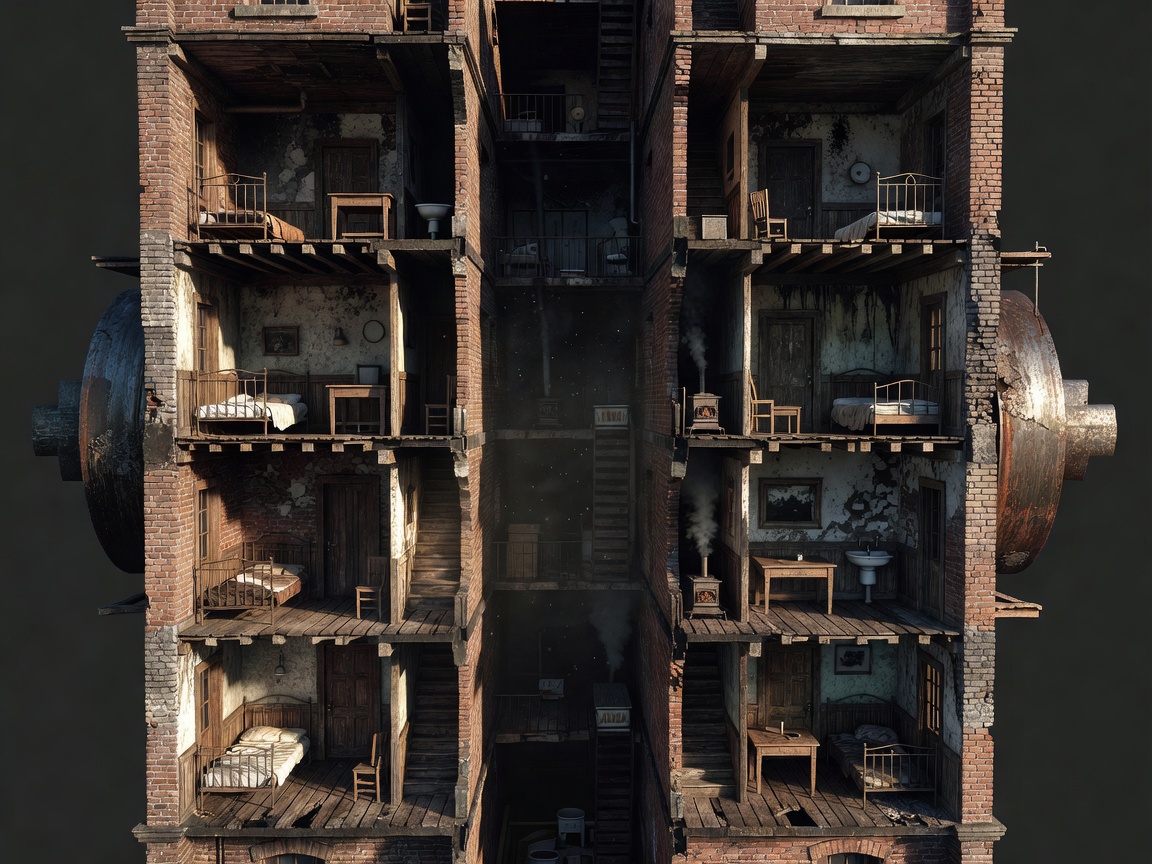
In New York City, the geographic constraint of Manhattan island led to vertical expansion for residential housing. The tenement emerged as the standard working-class dwelling. By the late 19th century, structures like the "dumbbell tenement"—designed to comply with the 1879 Tenement House Act—featured narrow air shafts intended to provide light and air to interior rooms. In reality, these shafts often became receptacles for garbage, exacerbating public health crises.
Public Health as an Architectural Catalyst
The appalling conditions of industrial slums directly catalyzed modern zoning laws and building codes. Figures like Jacob Riis, through his photojournalism work How the Other Half Lives, exposed the architectural failures of tenements, leading to the landmark New York State Tenement House Act of 1901.